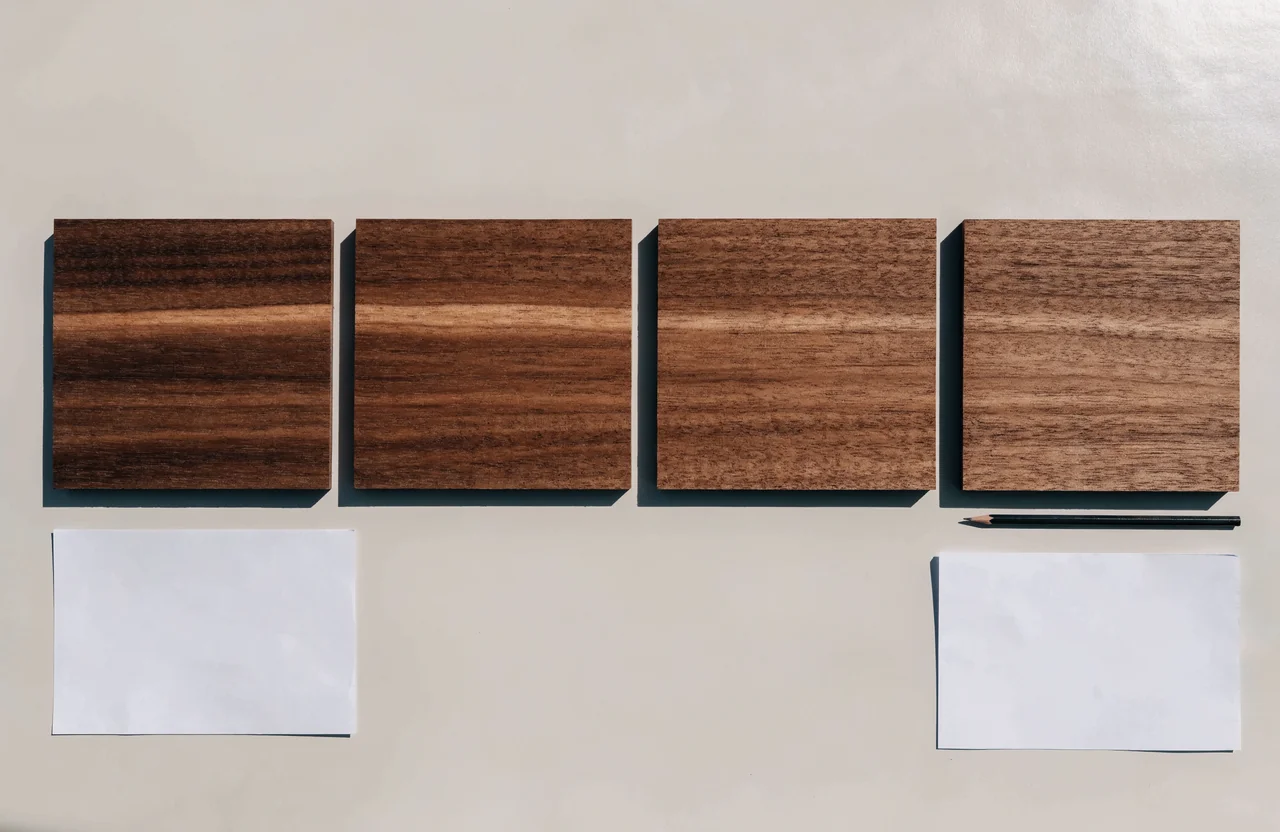
Review a representative range and identify what the sample acceptance covers. This material study does not establish species, grade or a supplied-product match.
Illustrative specification workspace. Blank records and samples do not establish product approval or acceptance criteria.Give each sample or mockup a purpose, identifier, review scope and retained record.
Choose the right review object
A small loose sample can show an edge profile or a range of surface characteristics. An assembled mockup can show joints, fastener visibility, transitions and workmanship together. State which questions the review is intended to resolve so a supplier does not send a display piece that cannot answer them. Identify the proposed product and finish system associated with the sample. Where several selections are being compared, label them consistently and avoid mixing raw and finished examples without explaining the difference.
Write the review conditions
Define size, components, preparation, location and participants in the project request. Include interfaces that would otherwise be concealed or difficult to assess after installation. Record whether the mockup is temporary, retained as a workmanship reference or potentially incorporated into the work under the project's process. A visual review of a mockup does not establish structural adequacy, weather resistance or a rating unless the relevant review or test has separately been specified and documented. Keep those evidence paths distinct in the submittal register.
Keep the reference usable
Assign an identifier to the reviewed object and record the outcome, reviewer, date and any conditions. Photograph the assembly for context while retaining physical references where required. Mark revised samples clearly so an obsolete finish choice cannot be mistaken for the selected one. If comments require another submission, carry the original issue forward until the replacement has a recorded disposition. Tell the installer where the reference is available and who may authorize a departure. This record makes the sample a practical working reference rather than an untraceable object left in an office.
Decide what each sample can approve
A small material sample can help discuss colour, grain and finish. It cannot show every joint, transition, attachment or installation sequence. List the decisions assigned to the sample and the decisions reserved for a larger assembly mockup.
Avoid an approval that says only “sample accepted.” Record the sample identity, supplier, preparation, finish and range represented, then identify the accepted characteristics. If natural variation is expected, one unusually uniform piece is a poor way to communicate the acceptable range. Ask for a representative set tied to the proposed supply.
A useful mockup review might accept the visible board direction and finish while leaving a corner joint unresolved. Carry that distinction into the review record. An appearance decision should not silently close an open attachment, drainage or material-interface question.
Write a bounded acceptance
Scroll sideways to read all columns. Keyboard: focus the table and use the arrow keys.
| Review item | Useful acceptance statement | Still required |
|---|---|---|
| Colour range | Reviewed against identified samples A–D | Supply matches the agreed basis |
| Surface finish | Identified finish and preparation reviewed | Application and maintenance instructions |
| Joint appearance | Specific mockup junction accepted visually | Technical acceptance of the assembly |
| Outstanding issue | Corner return held for revised detail | Named reviewer and revised submission |
Keep the accepted samples available for comparison through receiving and installation. When a replacement sample is submitted, preserve the previous decision and record what changed rather than overwriting the history.
Evidence & scope
Wood finishing background from FPL-GTR-282.
Original planning guidance. References support their stated technical scope; examples and workflows do not establish product approval.