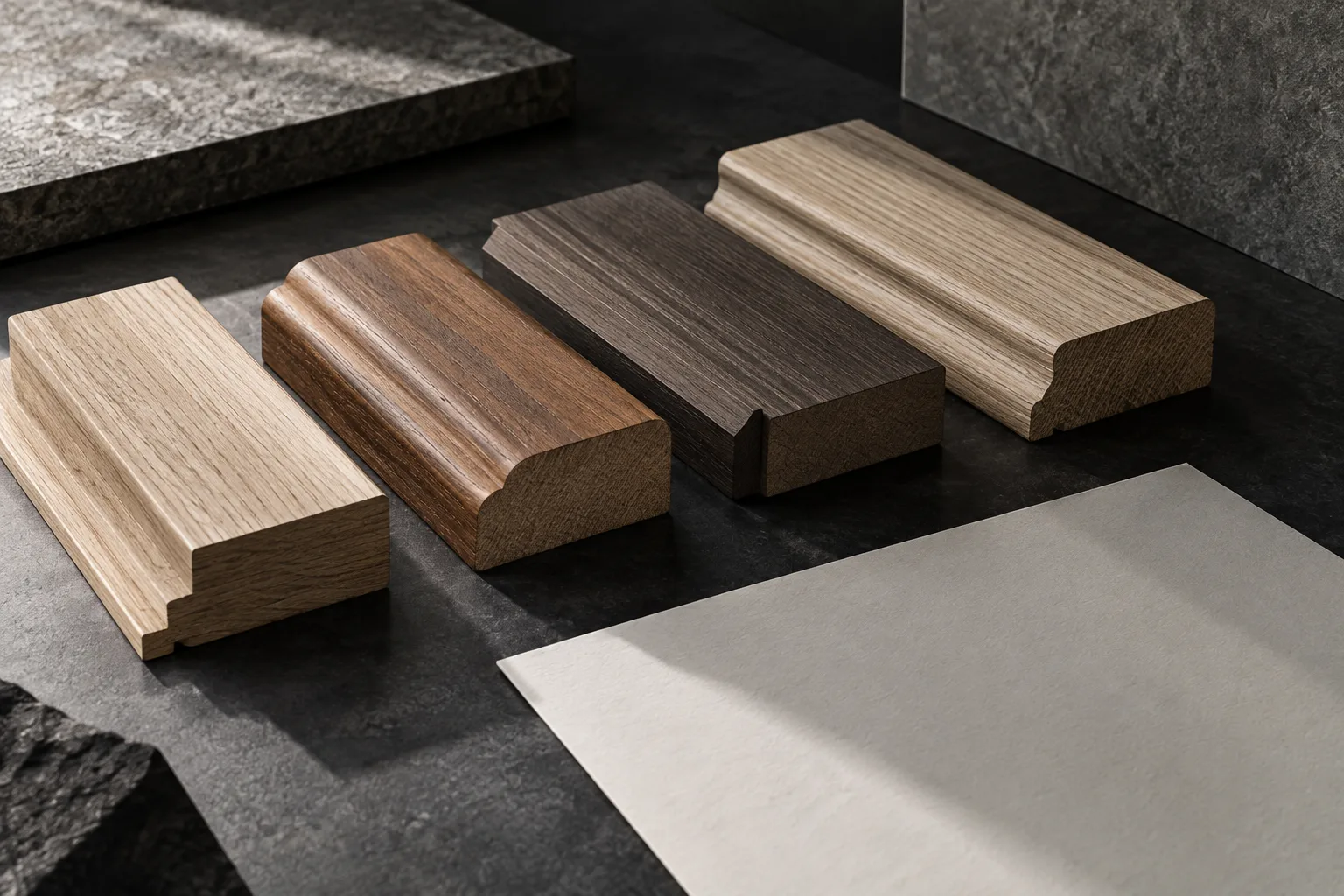
Specify the actual product geometry to be reviewed, including edges and grooves, and state the measurement basis.
Describe the whole section
A familiar board size is a useful purchasing label but may not describe the finished section. Record nominal designation and actual finished thickness and width as separate entries. Identify eased edges, grooves, tongues, relief cuts and any special machining that affects the exposed face or fastening interface. Ask for a dimensioned section drawing when the geometry matters. A photograph can clarify appearance but cannot establish a hidden groove location or a dimension. Use one unit system consistently, with any converted dimensions clearly labelled for reference.
Define lengths and measurement conditions
State whether the order uses fixed lengths, an allowed range, a length schedule or another agreed arrangement. Explain who develops the cutting and joint layout so a quantity estimate is not mistaken for a fabrication schedule. Dimensions in wood should be associated with the specified condition and verification method, because moisture affects dimensional behavior. The specification writer should request the applicable supplier tolerances rather than supplying arbitrary universal values. Record where and how a dimension is checked and who will decide whether an observed difference is acceptable.
Review the connected parts
A profile change may affect clips, trim, transitions, exposed gaps and replacement access. Compare the complete section with the attachment details before accepting a substituted product. Ask the installer to identify any field machining needed and the documentation supporting that operation. Keep engineered support spacing and connection design with the responsible design professional. Once the geometry has been reviewed, give its drawing a revision identifier and reference that identifier in the order. A verbal description such as same as sample should not become the only record of a dimensionally important selection.
Evidence & scope
General wood science context; chapters on lumber, moisture, fastening and finishing. Not a project specification or product approval.
Original planning guidance. References support their stated technical scope; examples and workflows do not establish product approval.